


The Nefertiti neck lift with Botox is a non-surgical cosmetic treatment that uses carefully placed injections of botulinum toxin type A to relax the platysma muscle, a thin sheet of muscle running from the collarbone up to the jawline. When this muscle relaxes, it stops pulling the lower face downward. The result is a more defined jawline, smoother neck, and a softer appearance of vertical neck bands, all without surgery, incisions, or any recovery time.
This treatment works best for people who have mild to moderate signs of aging around the neck and jaw. It is not a replacement for surgical procedures in cases of significant skin sagging or excess fat. Results typically last between three and six months, and maintenance treatments help extend them over time.
The treatment is named after Queen Nefertiti of ancient Egypt, a ruler famous for her long, elegant neck and sharply defined jawline, two things that people today still associate with a youthful, refined appearance.
In this blog, we cover everything you need to know: how the procedure works, what the science says, who makes a good candidate, what to realistically expect from the results, how it compares to surgical options, and how to choose a qualified provider.
Your Face Gets All the Attention, But Your Neck Tells the Real Story
Most people spend a lot of time and money taking care of their faces. Moisturizers, serums, sunscreen, facials, and Botox for forehead lines. But the neck? It often gets ignored.
Here is the thing: the neck can age faster than the face, and it is one of the first places where visible signs of aging appear. You might notice it in photos before you notice it in the mirror. A little looseness under the chin. Some bands form on the front of the neck. The jawline looks a little less sharp than it used to.
This happens for a few reasons. The skin on the neck is thinner than the skin on the face. It also has fewer oil glands, which means it dries out faster. Over time, collagen production slows down, and the skin loses the firmness it once had. Add to that the effects of gravity, sun damage, and repetitive movements, and the neck becomes one of the most visible signs of how our bodies change as we age.
The muscles underneath are part of the problem, too. A muscle called the platysma runs from your chest all the way up to your lower face. As we get older, this muscle can become more active and start pulling the skin downward. That pulling effect is what creates jowls along the jawline and those vertical cords or bands on the neck that many people find frustrating.
For a long time, the only real fix for this was surgery. But that has changed. Today, there are non-surgical options that can make a noticeable difference without putting you under the knife. The Nefertiti neck lift is one of them, and it has become one of the most talked-about treatments in aesthetic medicine.
Meet the Nefertiti Lift: The Non-Surgical Treatment Named After a Queen
The Nefertiti lift gets its name from Queen Nefertiti, who ruled ancient Egypt around 1350 BCE. She is widely regarded as one of the most beautiful figures in history, and images of her, especially the famous painted limestone bust housed in a Berlin museum, show a woman with an incredibly long, graceful neck and a jawline so sharp it almost looks sculpted.
That image became the inspiration for this treatment. The goal of the Nefertiti lift is not to make people look like a 3,400-year-old statue, but to use modern injectable techniques to create a similarly refined silhouette in the lower face and neck.
The treatment was first formally described in a 2007 paper by Dr. Philip Levy, a Swiss aesthetic physician, who published his technique in the Journal of Cosmetic and Laser Therapy. Since then, it has grown significantly in popularity as a non-surgical neck lift option, particularly among people in their 30s, 40s, and 50s who are starting to see early signs of aging but are not yet ready for surgery.
What makes this treatment different from regular Botox for wrinkles is not just where the injections go but the strategy behind them. A standard Botox treatment targets a specific wrinkle or muscle group. The Nefertiti lift uses a broader injection pattern along the lower jawline and down the neck, with the goal of creating a lifting effect across a larger area.
The treatment uses botulinum toxin type A, most commonly known by the brand name Botox, though it is also available as Dysport, Xeomin, and Nuceiva. All of these products work similarly. They are all neuromodulators, which means they temporarily affect how muscles receive signals from the nervous system.
The Platysma Muscle Is Quietly Aging Your Jawline, Here’s How
- To understand why the Nefertiti lift works, it helps to know what the platysma muscle is.
- The platysma is a thin, flat sheet of muscle located in the neck.
- It begins just below the collarbone and extends upward across the front and sides of the neck.
- It connects to the muscles and skin of the lower face.
- It is one of the largest muscles in the neck area, even though many people have never heard of it.
- When you are younger, the platysma usually stays flatter and does not create noticeable changes in appearance.
- As you age, the muscle can become more visible and active.
- One common change is the appearance of vertical neck bands or cords.
- These bands may show when you speak, move your jaw, or tense your neck.
- These visible lines are often called platysmal bands.
- Platysmal bands can make the neck look ropy, tighter, or older.
- The platysma can also pull downward on the lower face.
- This downward pull may contribute to jowls and a softer jawline.
- These are two connected issues:
- Visible neck bands caused by increased muscle activity.
- Jawline sagging is caused by downward tension on facial tissues.
- A simple way to picture it:
- Think of your face and neck like a tent.
- The upper facial muscles act like poles holding everything up.
- The platysma can act like someone pulling down on the bottom of the tent.
- Over time, everything starts to shift downward.
- Aging skin adds to the problem.
- Collagen, the protein that helps keep skin firm and elastic, naturally declines with age.
- This often becomes more noticeable after the mid 30s.
- With less collagen, the skin has less support and firmness.
- Gravity can then affect the skin more easily.
- Years of sun exposure can speed up these visible changes.
- This may lead to:
- Skin laxity
- Necklace lines
- Horizontal neck creases
- Jowl formation
- Less jawline definition
- The Nefertiti lift is designed to target this underlying issue.
- It focuses on the behavior of the platysma muscle beneath the skin, not just the skin surface itself.
How the Nefertiti Neck Lift with Botox Works: The Science Behind the Results
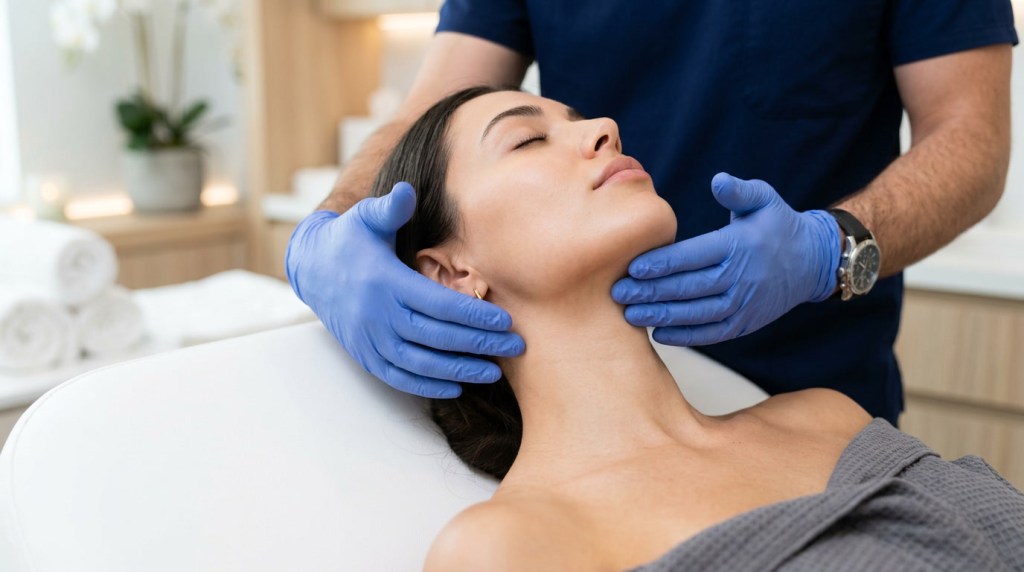 Here is the clear-cut answer to how the Nefertiti neck lift with Botox works:
Injections are administered into the platysma muscle along the jawline and down the neck. This causes the muscle to temporarily relax. When the platysma stops pulling downward, the muscles of the upper face that pull upward become relatively stronger. The result is a subtle but real lifting and smoothing effect along the jawline and neck, without surgery.
Now let’s break that down a little more.
Botox or botulinum toxin type A works at something called the neuromuscular junction. This is the point where a nerve meets a muscle fiber and sends a signal telling the muscle to contract. Normally, a neurotransmitter called acetylcholine carries that signal from the nerve to the muscle. Botox blocks the release of acetylcholine. No acetylcholine, no signal. No signal, no muscle contraction. The muscle temporarily relaxes.
This is the same basic mechanism that makes Botox effective for forehead lines, crow’s feet, and other areas where muscle movement causes wrinkles. The difference with the Nefertiti lift is the target muscle and the injection pattern.
In a standard Botox treatment, the injector usually targets a small group of muscles responsible for specific expression lines. In a Nefertiti lift, the injector places a series of small injections along the edge of the lower jaw and in a vertical line down the neck, targeting the platysma directly.
When done correctly, this achieves two things at once. It reduces the vertical neck bands by weakening the platysmal fibers that create them. And it softens the downward pull on the lower face, allowing the natural upward muscles to lift the area more effectively.
It is worth noting that this use of botulinum toxin in the platysma is considered off-label. That means the FDA has not specifically approved it for this particular use. However, off-label use of Botox is common in aesthetic medicine, and multiple clinical studies support the safety and effectiveness of the Nefertiti technique. A 2020 systematic review published in the Aesthetic Surgery Journal confirmed positive outcomes in patients treated with this method.
The key takeaway is that this treatment does not add anything to your face. It does not fill volume or tighten skin surgically. It simply reduces the muscle force that is working against your natural structure.
What Actually Happens During a Nefertiti Lift Botox Procedure
If you have never had any kind of injectable treatment before, you might be wondering what to actually expect when you walk into the room. The good news is that this is a quick and relatively simple procedure.
The process usually starts with a consultation. A qualified injector will examine your neck and jaw, look at how your platysma muscle moves, and ask you about your goals and medical history. This is an important step. Not everyone is a good candidate for this treatment, and a good provider will tell you honestly whether it is right for you.
Once you are ready for the actual treatment, the provider will mark the injection sites with a small pen or marker. These marks show exactly where each injection will go. The pattern typically includes a series of points along the jawline and down the neck, spaced roughly half an inch apart.
Some clinics apply a numbing cream to the treatment area beforehand. This makes the injections more comfortable, though most people find the discomfort minimal even without it. The needles used are very fine, and the injections are shallow, so the sensation is usually described as a light pinch.
The actual injection process takes about 15 to 30 minutes from start to finish. There are no incisions, no anesthesia, and no stitches. When it is done, you can go back to your normal day immediately. Many people schedule this treatment during a lunch break.
After the treatment, you will likely be advised to avoid rubbing or applying pressure to the treated area for the rest of the day. Lying flat for several hours after injection is also usually discouraged, as it can cause the product to migrate. You should also skip intense exercise for the rest of the day.
Mild redness or slight swelling at the injection sites is normal and typically fades within a few hours. Some people experience minor bruising, which usually resolves within a few days.
You will not see results right away. Botox does not work instantly. The neurotoxin needs time to affect the muscle. Most people begin to notice a change within five to seven days, and the full effect becomes visible around the 10 to 14-day mark. That is when the platysma has fully relaxed, and the lifting effect is most apparent.
Real Results: What a Nefertiti Lift Can and Cannot Do for Your Neck and Jawline
Let’s be straightforward here. The Nefertiti lift produces real, visible results, but they are subtle. This is not a dramatic transformation. It is a refinement.
What you can realistically expect after a Nefertiti lift:
A more defined jawline. When the platysma stops pulling downward along the jaw, the edge of the jaw looks crisper and more distinct. This is especially noticeable in photos and at certain angles.
Softer vertical neck bands. If platysmal bands are the main issue, most patients see a significant reduction in how visible these bands are, especially during movement.
A smoother neck surface. The overall texture and tone of the neck can look more even and less ropy after treatment.
Reduced jowling. For people whose jowls are primarily caused by the platysma pulling the skin down, the Nefertiti lift can help lift that area. This tends to work best when the skin still has decent elasticity.
A general sense of looking more rested and youthful. Patients often say they look fresher without anyone being able to point to exactly what changed.
What the Nefertiti lift cannot do:
It cannot remove excess skin. If you have significant skin laxity or loose, hanging skin around the neck, injectable treatments will not resolve that. A surgical neck lift would be more appropriate.
It cannot remove submental fat. The double chin or fullness under the jaw that comes from fat accumulation is not addressed by Botox. Treatments like Kybella or CoolSculpting would be better suited for that concern.
It cannot permanently fix anything. The results of a Nefertiti lift last approximately three to six months. After that, the effects of the botulinum toxin wear off, the muscle gradually regains its activity, and the treated area returns to its pre-treatment state.
When it comes to Nefertiti lift before and after outcomes, the best results are seen in people who have mild to moderate aging concerns, good skin elasticity, and visible platysmal activity. People with very advanced aging or severe skin laxity may be disappointed if they expect dramatic changes.
That said, for the right candidate, the results can be quite impressive, and they look natural, which is what most people want.
Downtime, Side Effects, and What to Expect After Your Treatment
One of the biggest reasons people choose the Nefertiti lift over surgery is the recovery time, or more accurately, the complete lack of it.
There is no downtime with this procedure. You can have the injections done and walk straight back into your day. No bandages, no swelling that lasts for weeks, no time off work, and no restrictions on social activities.
That said, there are a few mild side effects that some people experience, and it is important to know about them going in.
The most common side effect is mild bruising at the injection sites. This happens because the needle passes through small blood vessels just under the skin. The bruising is usually minor and fades within three to five days. Applying ice to the area after the treatment can help reduce this.
Some people notice slight redness or swelling around the injection points for a few hours after treatment. This is completely normal and goes away on its own.
A less common but possible side effect is temporary weakness in nearby muscles. If the botulinum toxin migrates slightly from the intended injection site, it can affect muscles in the surrounding area. In the neck, this could theoretically cause temporary difficulty with swallowing or speaking clearly, though this is rare when the treatment is performed by a skilled, experienced injector.
Facial asymmetry, where one side looks slightly different from the other, is another possible but uncommon outcome. Again, this is most often related to technique, which is why provider selection is so important.
It is also worth knowing that the use of botulinum toxin in the platysma is considered off-label. This does not mean it is unsafe; it simply means the FDA approved it for other uses first, and its use in the Nefertiti technique is supported by clinical evidence rather than a specific product approval for that area.
Allergic reactions to botulinum toxin are extremely rare. If you have had Botox before without issues, the risk is even lower. However, if you have a known allergy to any component of the product or certain neuromuscular conditions like myasthenia gravis or Eaton-Lambert syndrome, this treatment is not suitable for you. People who are pregnant or breastfeeding should also wait.
The bottom line: most people tolerate this treatment very well, experience only minor and short-lived side effects, and get back to their lives the same day.
Are You a Good Candidate for the Nefertiti Neck Lift in Vancouver?
The Nefertiti lift is not for everyone, so choosing the right candidate matters. It is often best for people in their 30s, 40s, or 50s with early to moderate aging around the neck and jaw, good skin elasticity, visible platysmal bands, and a jawline that is starting to soften due to muscle pull rather than excess fat. It also suits those who want subtle, natural-looking improvement without surgery or downtime. It may be less suitable for people with significant loose skin, heavy fullness under the chin, deep horizontal neck lines, or certain medical conditions such as neuromuscular disorders, active infections, or allergies to botulinum toxin products. The best way to know is through a professional consultation with a qualified injector who can assess your anatomy, goals, and whether the treatment is truly right for you.
Nefertiti Lift vs. Surgical Neck Lift: Which One Actually Makes Sense for You?
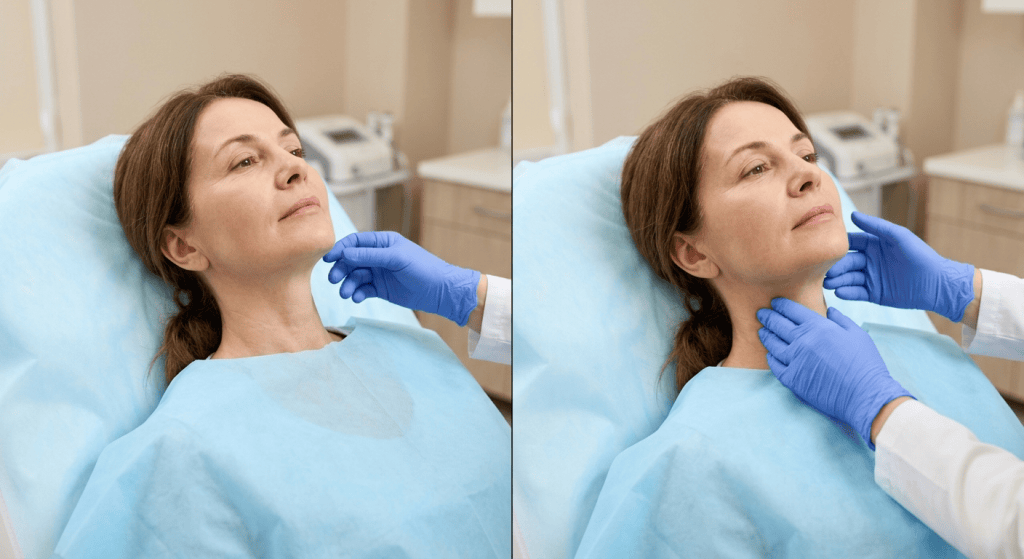 One of the most common questions people ask is whether the Nefertiti lift or a surgical neck lift is better, and the truth is, they are designed for different concerns. A surgical neck lift is a more advanced procedure that uses incisions, removes excess skin, tightens deeper tissues, and reshapes the neck and jawline with results that can last for years, but it also requires anesthesia, recovery time, and carries surgical risks. The Nefertiti lift is a quick non-surgical treatment that usually takes 15 to 30 minutes, involves no incisions or downtime, and offers subtle improvements that last a few months. It is best for early signs of aging, such as mild neck bands, a softening jawline, and light jowling, when skin still has good elasticity. Surgery is often the better option for significant loose skin or more advanced aging changes. Some people use the Nefertiti lift to delay surgery, while others combine it with treatments like radiofrequency microneedling to tighten skin, thread lifts for added lift, or dermal fillers to improve chin and jawline definition. The best choice depends on your anatomy, goals, and the severity of aging changes, which is why a consultation with a qualified provider is the smartest next step.
Botox, Dysport, Xeomin, Nuceiva: Which Neurotoxin Is Used in a Nefertiti Lift?
You may have noticed that the Nefertiti lift is described as a “Botox treatment,” but Botox is just one of several products that can be used. The procedure itself is defined by the technique and the target, the platysma muscle, not by a specific brand.
All of the following products contain botulinum toxin type A and work through the same basic mechanism: blocking the release of acetylcholine at the neuromuscular junction, which temporarily prevents the targeted muscle from contracting.
Botox is made by Allergan and is the most widely recognized name in the category. It has the longest track record in aesthetic medicine and the most extensive safety data. Most people’s default reference when they say “Botox” is this product specifically.
Dysport is made by Galderma. It tends to spread slightly more than Botox after injection, which can be an advantage in larger treatment areas like the neck. It also tends to take effect slightly faster. Some injectors prefer Dysport for the Nefertiti technique because of its diffusion properties. However, people with a known allergy to cow’s milk protein should avoid Dysport.
Xeomin is made by Merz and is notable because it does not contain accessory proteins. Some practitioners believe this reduces the risk of developing resistance to the toxin over time, though this is still debated in clinical literature. It is a clean, precise product.
Nuceiva (also known as Juveau in the U.S.) is made by Evolus Inc. and is one of the newest entrants in the neuromodulator category. It is made in Korea and functions similarly to Botox.
Which one is right for you? Honestly, the product matters less than the provider. In skilled hands, all of these products can produce excellent results. The difference between a great Nefertiti lift and a mediocre one is not which brand was used; it is the injector’s understanding of the platysma anatomy, their injection technique, and their ability to read each patient’s individual muscle patterns.
That said, if you have a specific preference or have reacted well to a particular product in the past, it is worth discussing that with your provider during your consultation.
How to Choose the Right Provider for Your Nefertiti Lift And Why It Matters More Than You Think
The Nefertiti lift is a technique-dependent procedure. More than almost any other injectable treatment, the outcome depends heavily on the skill and knowledge of the person performing it.
Here is why. The platysma is a large, complex muscle. It interacts with the muscles of the face above it and the muscles of the neck and chest below it. Injecting in the wrong location, at the wrong depth, or in the wrong amount can lead to problems. Uneven results, muscle weakness in areas you did not want affected, or a look that does not match your goals.
A skilled injector understands the anatomy deeply. They know how to map the platysmal bands on each individual patient, how the muscle connects to the jawline, and how to place injections in a way that creates balance rather than disruption. They also know how to assess whether a patient is a good candidate or whether a different treatment would serve them better.
When choosing a provider, there are a few things worth paying attention to. Make sure they are a licensed medical professional with specific training in aesthetic injectables. Look for someone with clear experience performing the Nefertiti technique specifically, not just general Botox experience. Ask to see before and after photos of their previous patients. Pay attention to how they conduct the consultation. A good provider asks questions, listens carefully, and explains your options honestly.
Be cautious of anyone who does not ask about your medical history, rushes through the consultation, or is not willing to explain the potential risks and limitations of the treatment. A trustworthy provider will tell you if the Nefertiti lift is not the right choice for your specific concerns.
At Ovo Medi Spa in Vancouver, the approach to every treatment starts with an in-depth consultation. The focus is always on natural, balanced results that suit your individual anatomy, not a one-size-fits-all approach. Every patient is different, and the treatment plan should reflect that.
Price is another consideration, though it should not be the deciding factor. The cost of a Nefertiti lift varies depending on the number of units used, the product chosen, and the provider’s experience level. On average, most treatments require 50-80 units of botulinum toxin for the neck and jawline area, though this can vary significantly depending on the individual’s muscle activity and anatomy.
Going with the cheapest option available is rarely a good idea when it comes to injectable treatments. A poorly executed Nefertiti lift can lead to uneven results or side effects that require correction. Invest in a qualified, experienced injector at a reputable medical spa or clinic.
Conclusion
The Nefertiti lift is one of the most elegant non-surgical options available today for people who want to address aging in the lower face and neck. It works with your body’s own anatomy rather than against it, relaxing a muscle that is pulling things downward so that everything above can sit where it naturally should.
It is not magic, and it is not surgery. The results are subtle and temporary, requiring maintenance every few months to stay consistent. But for the right person, someone with early to moderate aging, decent skin elasticity, and realistic expectations, it can make a genuinely meaningful difference in how they look and feel.
The science behind it is solid. The procedure is quick and comfortable. The recovery is essentially nonexistent. And when done by the right hands, the results look natural and refreshed rather than overdone.
If you have been noticing changes in your neck or jawline that bother you, and you are not ready or willing to go the surgical route, the Nefertiti lift is absolutely worth a conversation with a qualified provider.
If you are considering the Nefertiti neck lift and want to understand what it can realistically do for your specific concerns, the best first step is a proper consultation. Reach out to Ovo Medi Spa in Vancouver to speak with an experienced injector who can evaluate your anatomy, walk you through your options, and help you decide whether this treatment or something else entirely is the right path forward for you.
Frequently Asked Questions
How Many Botox Units Are Needed for a Nefertiti Lift?
Most patients need about 50-80 units, depending on platysma strength, neck size, and treatment goals. More units do not always mean better results. Too much can increase the risk of side effects. A skilled injector chooses the lowest effective dose for balanced, natural-looking improvement.
Is a Nefertiti Lift Painful?
Most people describe it as mild discomfort rather than pain. The needles are very fine, and injections are quick. Many clinics use numbing cream or ice beforehand to make treatment more comfortable.
Can You Combine a Nefertiti Lift with Other Treatments?
Yes. This is a common approach. Fillers can add jawline structure, while treatments like Morpheus8 help tighten skin and support collagen. Combining treatments can improve results by addressing multiple concerns at once.
How Is a Nefertiti Lift Different from Standard Botox?
Standard Botox treats smaller facial muscles to soften lines like forehead wrinkles or crow’s feet. The Nefertiti lift targets the platysma muscle along the jawline and neck to improve contour, lift, and lower face definition.
How Long Do Nefertiti Lift Results Last?
Results usually last 3 to 6 months. Faster metabolism and higher activity levels may shorten results. Most people return when they notice the effects starting to fade rather than waiting for full movement to return.


